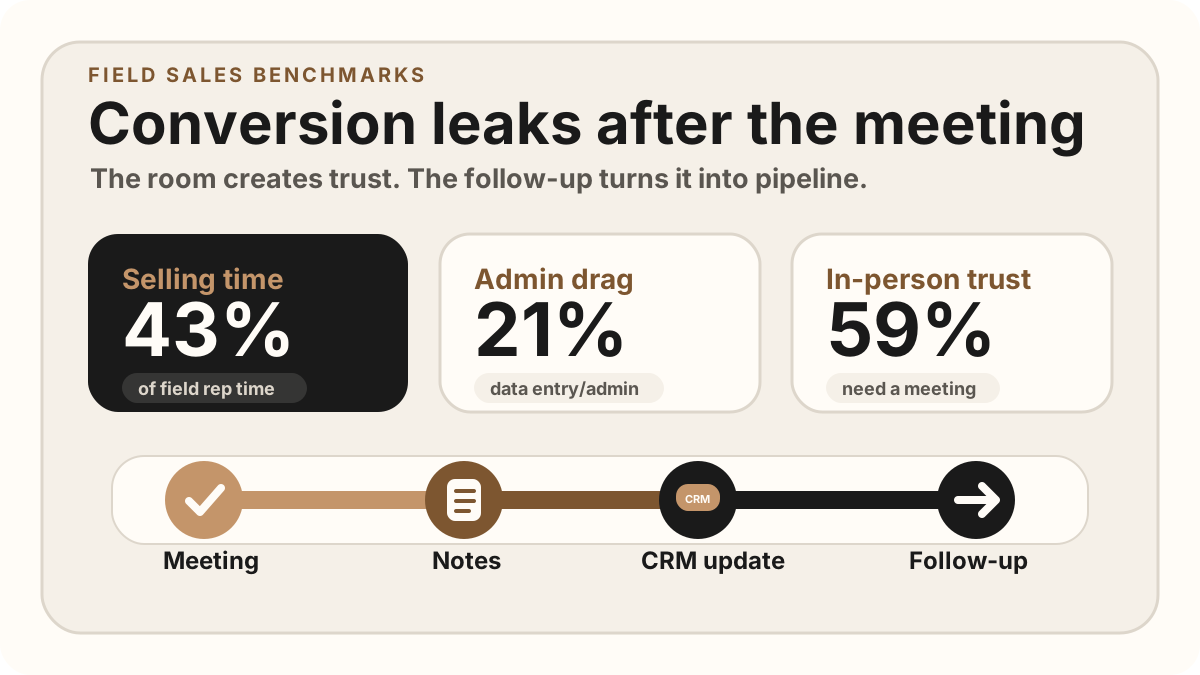
Field sales conversion is usually discussed like it is a personality test. Better reps. Better pitches. Better objection handling. That matters, of course. But the more practical story is quieter: a lot of conversion is won or lost after the conversation ends. That is why the broader field sales app stack matters.
A field sales rep leaves a customer site with names, objections, pricing questions, follow-up promises, and a next step. Then another meeting starts. Then another. By the time the CRM gets updated, the note often says something like "follow up next week." Technically true. Not very useful.
The biggest field sales conversion leak is not the meeting. It is the handoff from meeting context to follow-up and CRM.
Quick Answer: Which Field Sales Conversion Stats Should Teams Act On?
The most useful field sales conversion stats point to the same operating problem: reps have limited selling time, in-person meetings still build trust, buyers continue the journey across many channels, and CRM admin can erase the context that made the visit valuable. A field sales team should use those stats to tighten the handoff from customer visit to CRM update, not just to report generic activity.
Start with three metrics: how much time reps lose to admin, how quickly each visit becomes a specific follow-up task, and whether the CRM captures the buyer signal, objection, owner, due date, and sync status. Then connect the workflow to the broader field sales app stack: route planning before the visit, mobile CRM during the field day, notes and action items immediately after the conversation, and automatic CRM sync into Salesforce, HubSpot, or Google Sheets.
- If conversion stalls after good visits: track whether every customer promise becomes an owned task with a due date before the next stop starts.
- If reps complain about admin: measure how often visit notes, follow-up tasks, and CRM fields are generated from captured meeting context instead of rewritten at night.
- If managers cannot coach the field team: require each visit record to include outcome, buyer signal, objection, next step, CRM destination, sync status, and sync status.
Field Sales Conversion Statistics at a Glance
Here are the stats worth paying attention to before building a field sales workflow for 2026.
| Statistic | What it means for field sales | Source |
|---|---|---|
| Field reps spend 43% of time selling. | Every extra admin step takes time from customer conversations. | SPOTIO 2026 sales statistics. |
| Field reps spend 21% of time on admin and data entry. | CRM updates should happen from captured meeting context, not end-of-day memory. | SPOTIO 2026 sales statistics. |
| 59% of B2B customers will buy only after meeting in person at least once. | Face-to-face meetings are still a serious conversion channel. | McKinsey B2B sales research. |
| 76% say face-to-face visits signal that a supplier values the relationship. | The in-person meeting builds trust, but only if the next step proves the seller listened. | McKinsey B2B sales research. |
| B2B customers use ten or more channels. | Meeting notes need to move into the CRM because buyers keep engaging across email, calls, forms, and follow-up. | McKinsey B2B omnichannel research. |
| Buyers are 1.8x more likely to complete a high-quality deal when digital tools are used with a sales rep. | The best workflow is not human-only or software-only. It is a good rep supported by clean digital context. | Gartner B2B buying journey research. |
How to Turn Field Sales Stats Into a Conversion Workflow
Statistics are useful only when they change the workflow. For field sales teams, the best use of these benchmarks is to look for the handoff moments where customer context disappears: the car, the hotel lobby, the next route stop, the end-of-day CRM update, and the manager review.
| Benchmark signal | Conversion question | Workflow response |
|---|---|---|
| Limited selling time | Are reps spending prime hours with customers or rewriting notes? | Use a mobile CRM workflow that turns field notes into CRM-ready summaries and tasks. |
| Admin and data entry drag | Does the post-visit process create clear next steps or just activity logs? | Capture the conversation once, then sync notes, tasks, owners, and due dates into CRM. |
| In-person trust still matters | Does follow-up prove the rep listened during the customer visit? | Use a sales visit notes app to preserve buyer needs, objections, and promises. |
| Buyers use many channels | Can the next teammate see what happened in the field? | Push visit context into CRM so email, calls, tasks, and pipeline reviews all start from the same facts. |
| Digital tools work better with reps | Does the software support the rep or force the buyer to self-serve? | Keep the rep in the relationship while the app handles summaries, follow-up tasks, and CRM hygiene. |
Use this benchmark table as rollout guardrails, not trivia. Pick one metric that should improve, decide which CRM fields prove a visit created a next step, and pilot the workflow with one route team before expanding it. The companion field sales app rollout plan turns those guardrails into a territory-by-territory adoption sequence.
Field Sales Conversion Metrics by Workflow Stage
The benchmark numbers point to one operational question: where does conversion context disappear? A field team can answer that by tracking the handoff at each stage of the customer visit, not only the final win rate.
| Workflow stage | Conversion metric to watch | What good looks like |
|---|---|---|
| Before the visit | Qualified visits, account priority, open task review, and last-touch context. | The rep knows why the visit matters before walking in. |
| During the meeting | Buyer signal, objection, stakeholder change, timing, and decision criteria captured. | The conversation creates usable context instead of a thin activity log. |
| Right after the visit | Next step created, owner assigned, due date set, and CRM destination selected. | The follow-up is specific enough to act on before the next stop starts. |
| CRM handoff | Notes synced, tasks synced, opportunity updated, and missing fields reviewed. | Salesforce, HubSpot, Google Sheets, or the CRM record shows what happened and what comes next. |
| Manager review | Follow-up completion, stuck promises, CRM completeness, and conversion by visit type. | Managers coach the real conversion gaps instead of chasing reps for updates. |
The Conversion Leak Happens After the Meeting
Field sales has a weird problem. The most valuable context is created in the room, but the system of record usually gets updated later. That delay creates a gap.
In the gap, names get fuzzy. Objections become generic. Promises lose owners. Dates become "next week." The CRM gets an activity record, but not the real sales context. That is how a good meeting becomes a weak follow-up.
The conversion lesson is simple: the faster a field sales team turns meeting context into a clear next action, the less value leaks out of the conversation. For the phone capture step, see how to record a meeting on iPhone for sales notes. For the post-visit task step, see the field sales follow-up app guide.
Field Reps Do Not Have Much Selling Time to Waste
SPOTIO's 2026 sales statistics report that field reps spend 43% of their time selling and 21% on admin and data entry. That is a painful split because field sales already carries travel time, scheduling friction, and between-meeting gaps.
If a rep has to rewrite meeting notes, create CRM tasks manually, update contact records, and prepare the follow-up from memory, the system is taking selling time and turning it into clerical work. A cleaner workflow starts with reducing CRM admin after the meeting.
The hidden cost of a vague CRM update
Meeting note: "Good conversation with Alex."
What the team actually needed: Alex asked for implementation timing, wants pricing for 12 seats, mentioned security review, and expects a follow-up by Friday.
Conversion risk: The CRM says the meeting happened, but the next action is not specific enough to move the deal.
In-Person Meetings Still Matter for Trust
McKinsey's B2B sales research is useful because it pushes against the idea that field sales is old-fashioned. It reports that 59% of B2B customers will buy only if they have met in person at least once. It also reports that 76% say face-to-face visits signal that a supplier values the relationship.
That does not mean sales teams should schedule meetings for the sake of meetings. It means the in-person meeting still carries trust. The customer notices whether the rep listened, whether the follow-up reflects the conversation, and whether the next step feels specific.
The meeting earns attention. The follow-up proves whether the attention was deserved.
The Buyer Journey Is Hybrid Now
McKinsey also reports that B2B customers now use ten or more channels to interact with suppliers. A buyer may meet a rep in person, reply to an email, visit the website, share a document internally, ask procurement a question, and then return to the rep days later.
That is why field notes cannot stay in a notebook or a phone memo. The meeting has to become CRM context. Otherwise the next person touching the account sees only a thin activity log.
Gartner's B2B buying journey research adds another useful point: buyers are more likely to complete a high-quality deal when digital tools are used with a sales rep, rather than forcing the buyer to work independently. The better interpretation is not "replace the rep with software." It is "give the rep better software support."
Simpler Field Sales Stacks Convert Better
One of the more useful points from SPOTIO's field sales research is that low-turnover teams are more likely to run on fewer systems and use CRM or field sales platforms consistently. That matches what most sales people feel in practice: too many tools create avoidance.
The ideal field sales stack should not ask a rep to update five places after every meeting. It should connect route planning, mobile CRM, field sales CRM notes, and follow-up into one clean handoff:
- Capture the conversation: Meeting notes, objections, names, numbers, and promised follow-ups.
- Structure the context: Summary, action items, owners, due dates, and CRM-ready details.
- Sync the system of record: CRM notes, CRM tasks, or Google Sheets rows.
- Trigger the next step: Follow-up email, reminder, task, or pipeline update.
Field Sales Conversion CRM Field Map
Conversion data is useful only if it lands where the sales team works. A manager cannot coach from a vague activity count, and a rep cannot follow up from a note that never reached the right account record.
| Conversion field | Why it matters | Where it should land |
|---|---|---|
| Account and contact | Ties the customer visit to the record that owns the relationship. | Salesforce account or opportunity, HubSpot company or deal, or Google Sheets account row. |
| Visit outcome | Shows whether the visit created progress, risk, no action, or a next step. | Activity outcome, call report, route report, or status field. |
| Buyer signal | Preserves the pain, objection, stakeholder change, budget cue, timing, or competitor mention. | CRM note, opportunity note, contact timeline, or account history. |
| Promised follow-up | Turns the conversion moment into work someone can complete. | CRM task, reminder, follow-up queue, or shared task row. |
| Owner and due date | Makes accountability measurable after the customer visit. | Task owner, due date, next-step field, or team tracker. |
| Sync status | Shows whether the conversion data reached CRM or still needs review. | Synced, queued, needs review, or no-action status. |
For CRM-specific handoff workflows, see the guides on Salesforce sync, HubSpot sync, and Google Sheets CRM.
What Sales Teams Should Do With These Stats
The takeaway is not "do more field sales." The takeaway is to protect the value of the field sales meetings you already have.
- Audit the post-meeting workflow. Look at what happens in the first 15 minutes after a customer meeting.
- Reduce manual CRM writing. If reps are rewriting notes at night, the process is already leaking context.
- Make follow-up specific. Every follow-up should include the promise, owner, date, and reason it matters.
- Keep the stack mobile-first. Field sales tools should work between meetings, not only from a desk.
- Measure CRM completeness. A completed activity is not enough. The CRM should show what happened and what comes next.
Where LogicNotes Fits
LogicNotes is built for the handoff after an in-person sales meeting. Record the conversation on your iPhone with consent, get a clean AI summary and action items, then let the notes and tasks sync automatically to your CRM or Google Sheets automatically.
It does not replace the field sales rep. It removes the admin drag between the rep and the next customer conversation.
Field Sales Conversion FAQ
What is field sales conversion?
Field sales conversion is the process of turning in-person customer visits into qualified next steps, opportunities, follow-up tasks, and closed revenue.
Which field sales statistic matters most for CRM workflow?
Admin time is one of the most useful workflow signals. If reps spend too much time rewriting notes and updating CRM manually, the team loses selling time and meeting context. For broader benchmarks across automation, agents, productivity, and sales workflows, see the AI workflow automation statistics page.
Which field sales conversion metrics should managers track?
Managers should track qualified visits, captured next steps, follow-up speed, CRM completeness, task ownership, opportunity creation, and whether customer promises are closed out after each visit.
How do field sales apps improve conversion?
Field sales apps improve conversion when they help reps capture visit context, create follow-up tasks, update CRM, and keep managers aligned before details fade.
Can field sales conversion data sync to Salesforce, HubSpot, or Google Sheets?
Yes. Field sales conversion data can sync to Salesforce, HubSpot, or Google Sheets when visit outcomes, meeting summaries, next steps, task owners, due dates, opportunity updates, and sync status are captured in structured fields.
What field sales conversion data should CRM capture?
CRM should capture the account, contact, visit outcome, buyer signal, objection, promised follow-up, task owner, due date, opportunity impact, and whether the update was synced or still needs review.
Why do meeting notes affect field sales conversion?
Meeting notes preserve buyer needs, objections, promised follow-up, stakeholders, and dates. Without that context, follow-up becomes vague and deals can stall after a good customer visit.
How fast should reps update CRM after a field sales visit?
Reps should update CRM while the visit context is still fresh, ideally before the next stop or immediately after the route block, because names, objections, dates, and promises decay quickly.
Do in-person meetings still matter for field sales conversion?
Yes. In-person meetings still matter for trust and relationship context, but their conversion value depends on whether the team captures the conversation and follows up with specific next steps.
How can teams improve field sales conversion after customer visits?
Teams can improve conversion by capturing meeting context quickly, turning promises into owned action items, syncing CRM while details are fresh, and using a small mobile-first app stack that reps actually use.
Turn field sales meetings into CRM-ready follow-up.
If your team has strong customer conversations but weak CRM updates later, LogicNotes was built for that gap.
Download LogicNotes for iOS